/ USD 
0
$0.0
Your Cart
empty cart Your cart is currently empty! Return to Shop
Remove All Items
/ USD 
0
Your Cart
empty cart Your cart is currently empty! Return to Shop
Remove All Items

3. Hydraulic Steering Valve

Price range: $1,346.1 through $1,404.6 + VAT

SKU N/A Category

Description

Developed and tested by members of the AgOpenGPS community. There are no development costs, as it is produced in a small-scale manufactory. Solutions are available for almost every tractor. Today, hundreds of units are in operation worldwide.

Warning: Designing a hydraulic steering control involves modifying one of the tractor’s primary systems. It has been reviewed by several engineers; if it does not receive power – meaning the AgOpen main switch is turned off – it theoretically cannot interfere with the steering. There have been no negative safety experiences to date. Regardless, everyone uses it at their own risk.

To select the appropriate hydraulic valve block (OC or LS) for your autosteer kit, check the tractor’s steering orbitrol unit. Orbit: the hydraulic block located at the “far” end of the steering shaft. No electricity flows into it.
Count the number of hydraulic lines connected to it:

  • 4 lines = OC (Open Center) valve block, typical for older tractors like MTZ, etc., but many smaller modern tractors still use this to this day.
  • 5 lines = LS (Load Sensing) valve block, found on almost every John Deere. For Fendt and/or tractors over 220 hp, use the LS Universal 60.

OC (Open Center) vs. LS (Load Sensing) Hydraulic Systems

System Type Meaning How to Decide / Identification Function and Features
OC Open Center Check the steering orbitrol. An OC system is generally identified by 4 hydraulic lines connected to the orbitrol. This is an older, simpler design that typically uses a fixed-displacement pump. When the steering wheel is in its center (neutral) position, oil flows continuously through the valve and back to the tank.
LS Load Sensing Check the steering orbitrol. An LS system is identified by an extra, fifth hydraulic line. This fifth branch is the dedicated Load Sensing signal line. * This is a more modern and energy-efficient system, typically using a variable-displacement pump. The pump only delivers oil when the system actually needs it, controlled by the extra load-sensing (LS) line.
LS 60l Universal Load Sensing (High Power) Check the orbitrol, as well as the tractor’s horsepower and model. Choose this if the tractor’s power is more than 220 HP, and/or if the machine is a Fendt model equipped with an LS system. Operates on the same principle as LS but with higher flow capacity, specifically optimized for high-performance machines and Fendt models.

*Note for some Fendt tractors: An extra fifth line may be present at the rear implement connectors that is not a Load Sensing (LS) branch – in such cases, you need an OC valve. This fifth line often serves as a Case Drain or a trailer brake line. It is crucial to accurately identify the function of each branch for your specific tractor model, as the LS line is specifically designed to control the pump flow.

Technical Types of LS Systems: Static vs. Dynamic

Additional complexity: The autosteer valve block must match the behavior of the LS signal line:

1. Static LS (Static)
  • Operation: When both the steering wheel and the autosteer are stationary, the signal line (LS branch) is completely depressurized and there is no flow. The pump is in “sleep” mode.
  • Our “standard” LS valve: This block is a static design. If it were placed on a dynamic system, the continuous pilot flow would “trick” the valve, generating unnecessarily high pressure.
2. Dynamic LS (Dynamic)
  • Operation: The system maintains a minimal, continuous oil flow (so-called “pilot” flow) in the LS signal line even in the neutral position.
  • Advantages:
    • Faster reaction: The pump reacts immediately, as it doesn’t have to wait for the signal line to fill with oil.
    • Cold operation: The circulating oil keeps the system warm, preventing the steering from slowing down in winter.
  • Typical application: Modern, premium machines such as Fendt.

Additional information

Weight N/A
type

OC, LS, LS 60l universal

Adapters for different tractors

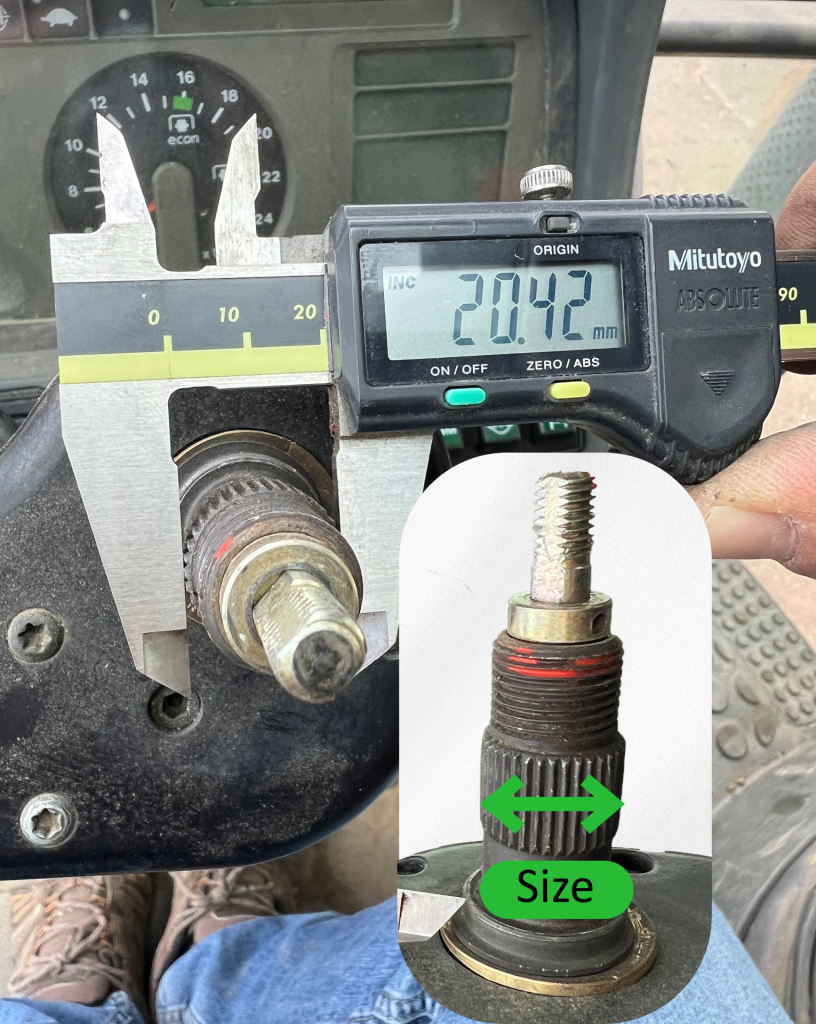
To ensure you select the correct adapter, the most reliable method is to remove the steering wheel and measure the diameter of the splined shaft, as shown in the image.

In most cases, the spline count is 36; therefore, the diameter is the determining factor. Based on our experience, dimensions are consistent across certain brands.

Models for which the data in the table below are highly reliable:

  • John Deere and newer machines from the CNH Group: A+

  • Claas and Massey Ferguson: N

Adapter Model Tractor Brands & Models Adapters teeth no. Adapters size

A+

  • JOHN DEERE      (ALL)

CNH group newer:

  • CASE                    (PUMA, Maxxum, 5150, 110)
  • NEW HOLLAND    (1404, 2104, 6070, 110-90, 165, TD85D, 1654, 1304, T5.120, TC56)
  • STEYER
  • LANDINI                (6-115H, Powerfarm 95)
  • DEUTZ                   (Agrofarm 420 y2012)
  • LAMBORGHINI     (874-90 Turbo)
  • REANULT              (French, 11404)
  • ZOMMLION          (2604)
  • ARMATRAC
  • YTO                       (smaller ones to 90hp)
36
21.8-22.1

D

  • FENDT                (ALL)
  • CASE                  (CVX 1170)
  • DEUTZ                (5110 , 5105, Agrotron XXX)
  • KUBOTA             (M7-153)
  • LANDINI              (Vision 100)
  • LAMBORGHINI
36
20.4

K

  • BELARUS MTZ            (824, 1204)
36
17.8

N

  • MASSEY FERGUSON  (6475, 5413, 204, S1304-C, 1004, 1104, 1204, 1304, 8690, 6713S)
  • CLAAS                          (Axion y2008, 2204, 440)
  • MCCORMICK               (MC120, XTX185, ZTX280, MTX)
  • CASE                             (PUMA145, 185CVX, MX 110)
  • VALTRA                         (N154)
  • STEYR                            (6125)
36

15.8
(conical)

B

  • LOVOL              (1004, 900, 1654)
  • WORLD            (1304, 2204, 604, 904, 1404, 1604)
  • FOTON             (904, 700, 750, LX800, 754, 90, LF904, 1204)
  • YTO                   (120/130hp)
36
18.2

W

  • DEUTZ           (904, 454, 604, 704, 804, 1204, 1604, 1654)
  • LOVOL        (1304, 900, 904, 654, 1204, 1504, 800)
  • FOTON          (small ones)
36
18.5

F

  • VALTRA       (2104, 191, 1904, 1504, 8158, T183, T171, N143)
  • ZETOR
  • KIROVETS    (K-734)
  • BATEMAN
  • SANDS
  • KNIGHT        (SP sprayers)
  • HARDI          (Alpha)

single key

24.5

NH40

older ones:

  • NEW HOLLAND     (1304, TS100, T5050)
  • CASE                      (MXM)
40
17.7

T

  • KUBOTA                 (594)
  • YANMAR                (AC21W, rice transplanter)
18
15.45

G

RARE: 

  • MASSEY FERGUSON              (4365, old ones)
  • CASE & NEW HOLLAND        (old, manufactured in the US)
36
15.6

C

  • CLAAS             (Lexion)
  • TUCANO
  • AVERO
  • JAGUAR
single key (conical)
23.33-25.4

BENZ- 72S

  • MERCEDES      (Unimog)
72
23.5

When do I need a 4G router?

Add an external 4G router to your kit if: 

  • Tablet has no LTE modem: Your tablet lacks a built-in SIM slot, and you don’t want to rely on your phone’s mobile hotspot.
  • Weak signal coverage: The external antennas provide a stable internet connection in remote fields where standard mobile phones often lose reception.
  • Section controller setup: You are using an extra control board for automatic section control or sprayer management. This setup utilizes the router’s Ethernet hub function, where a third Ethernet cable is connected directly to the SC to ensure seamless communication between the devices.